Assessment of fault sealing capacity in Structure A, Oligocene reservoir, Northeastern Cuu Long Basin
Abstract
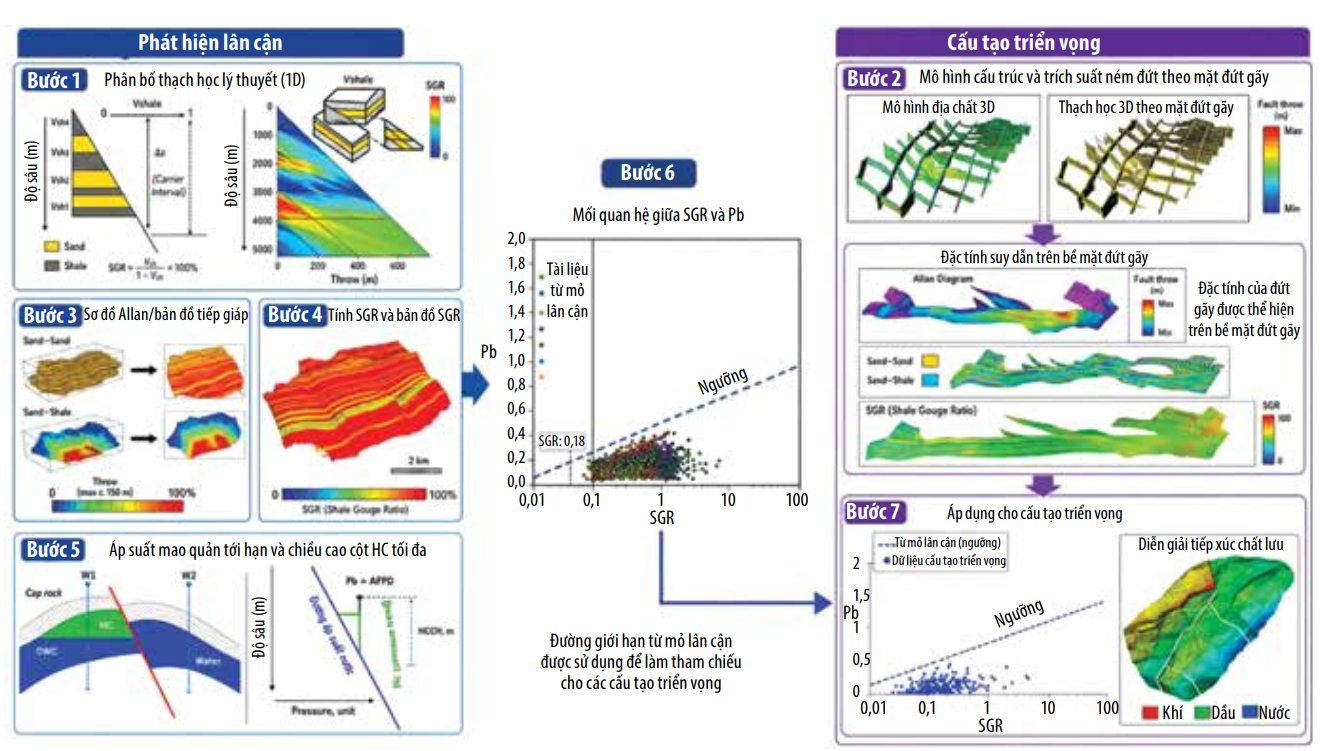
Statistics indicate that more than 85% of hydrocarbon traps are juxtaposed against and/or directly dependent on the sealing capacity of fault systems. Therefore, the interpretation and quantitative assessment of fault sealing capacity in prospective structures is critical in petroleum geology. At present, fault seal capacity is commonly evaluated using two main approaches: direct and indirect approach. The direct approach determines fault sealing capacity based on experimental capillary pressure measurements on core samples collected directly from the fault damage zone or fractured zone. The indirect approach predicts fault sealing capacity by comparison with the sealing characteristics of nearby discovered structures through correlations between quantitative attributes on the fault surfaces, particularly the shale gouge ratio (SGR), and the pressure differential across the fault. Threshold values established from field data provide the basis for evaluating the sealing potential of undrilled structures.Quantitative assessment of fault sealing capacity not only improves the calibration of the probability of geological success for undrilled structures but also provides a scientific basis for predicting the hydrocarbon column height that can be retained within prospective structures.
References
Anne Briais, Philippe Patriat, and Paul Tapponnier, “Updated interpretation of magnetic anomalies and seafloor spreading stages in the South China Sea: Implication for the Tertiary tectonics of southeast Asia”, Journal of Geophysical Research B: Solid Earth, Volume 98, pp. 6229 - 6328, 1993. DOI: 10.1029/92JB02280.
P. Ted Doughty, “Clay smear seals and fault sealing potential of an exhumed growth fault, Rio Grande rift, New Mexico”, AAPG Bulletin, Volume 87, Issue 3, pp. 427 - 444, 2003. DOI: 10.1306/10010201130.
P. Huchon, X. Le Pichon, and C. Rangin, “Indochina Peninsula and the collision of India and Eurasia”, Geology, Volume 22, Issue 1, pp. 27 - 30, 1994.
Tung-Yi Lee and Lawrence A. Lawver, “Cenozoic plate reconstruction of Southeast Asia”, Tectonophysics, Volume 251, Issue 1 - 4, pp. 85 - 138, 1995. DOI: 10.1016/0040-1951(95)00023-2.
Philippe Hervé Leloup, Robin Lacassin, Paul Tapponnier, Urs Schärer, Zhong Dalai, Liu Xiaohan, Zhang Liangshang, Ji Shaocheng, and Phan Trong Trinh, “The Ailao Shan-Red River shear zone (Yunnan, China), Tertiary transform boundary of Indochina”, Tectonophysics, Volume 251, Issue 1 - 4, pp. 3 - 10, 13 - 84, 1995. DOI: 10.1016/0040-1951(95)00070-4.
L.H. Nielsen, A. Mathiesen, T. Bidstrup, and O.V. Vejbaek, “Modelling of hydrocarbon generation in the Cenozoic Song Hong basin, Vietnam: A highly prospective basin”, Journal of Asian Earth Sciences, Volume 17, Issue 1 - 2, pp. 269 - 294, 1999. DOI: 10.1016/S0743-9547(98)00063-4.
John D. Pigott and Ke Ru, “Basin superposition on the Northern margin of the South China Sea”, Tectonophysics, Volume 235, Issue 1 - 2, pp. 27 - 50, 1994.
Richard M. Jones and Richard R. Hillis, “An integrated, quantitative approach to assessing fault seal risk”, AAPG Bulletin, Volume 87, Issue 3, pp. 507 - 525, 2003. DOI: 10.1306/10100201135.
R.S.J. Tozer and A.M. Borthwick, “Variation in fluid contacts in the Azeri field, Azerbaijan: sealing faults or hydrodynamic aquifer?”, Geological Society, London, Special Publications, Volume 347, pp. 103 - 112, 2010. DOI: 10.1144/sp347.8.
Peter R. Rose, “Chance of success and its use in petroleum exploration”, The business of petroleum exploration. American Association of Petroleum Geologists, 1992.
P. Tapponnier, R. Lacassin, P. H. Leloup, U. Schärer, Zhong Dalai, Wu Haiwei, Liu Xiaohan, Ji Shaocheng, Zhang Lianshang, and Zhong Jiayou, “The Ailao Shan/Red River metamorphic belt: Tertiary left-lateral shear between Indochina and South China”, Nature, Volume 343, pp. 431 - 437, 1990. DOI: 10.1038/343431a0.
Graham Yielding, “Shale gouge ratio - Calibration by Geohistory”, Norwegian Petroleum Society Special Publications, Volume 11, pp. 1 - 15, 2002. DOI: 10.1016/S0928-8937(02)80003-0.
P. Watson, “A process for estimating geological risk of petroleum exploration prospects”, Australian Petroleum Production and Exploration Association Journal, Volume 38, Issue 1, pp. 577 - 583, 1998. DOI:10.1071/AJ97033.
1. The Author assigns all copyright in and to the article (the Work) to the Petrovietnam Journal, including the right to publish, republish, transmit, sell and distribute the Work in whole or in part in electronic and print editions of the Journal, in all media of expression now known or later developed.
2. By this assignment of copyright to the Petrovietnam Journal, reproduction, posting, transmission, distribution or other use of the Work in whole or in part in any medium by the Author requires a full citation to the Journal, suitable in form and content as follows: title of article, authors’ names, journal title, volume, issue, year, copyright owner as specified in the Journal, DOI number. Links to the final article published on the website of the Journal are encouraged.