Marine diatom assemblages from surface sediments of Southeastern part of Nam Con Son basin
Abstract
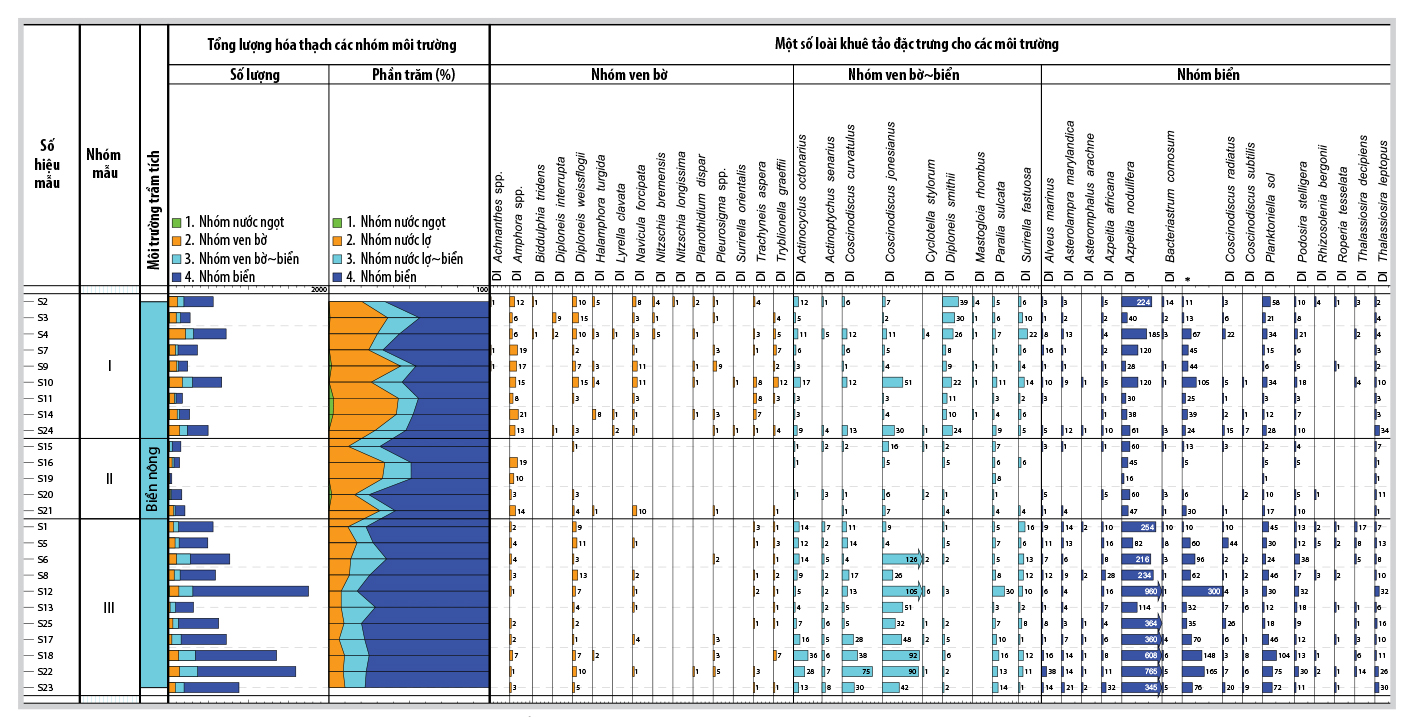
The paper presents the characteristics of diatom assemblages taken from 25 samples of surface sediments in the southeastern part of Nam Con Son basin. The characteristics of diatom assemblages indicate a neritic condition and tropical climate. Three diatom assemblages were distinguished due to the significant differences in the total abundance and species composition. The result shows a clear suitability between the distribution of diatoms and the ecology of the samples in the study area.
References
Hui Jiang, Yulong Zheng, Lihua Ran, and Marit Solveig Seidenkrantz, “Diatoms from the surface sediments of the South China Sea and their relationships to modern hydrography”, Marine Micropaleontology, Vol. 53, No. 3 - 4, pp. 279 - 292, 2004. DOI: 10.1016/j.marmicro.2004.06.005.
Yue Huang, Hui Jiang, M. Sarnthein, Karen Luise Knudsen, and Dongling Li, “Diatom response to changes in palaeoenvironments of the northern South China Sea during the last 15000 years”, Marine Micropaleontology, Vol. 72, No. 1 - 2, pp. 99 - 109, 2009. DOI: 10.1016/j.marmicro.2009.04.003.
Meiqin Sun, Dongzhao Lan, and Zhimin Cao, “Diatoms from the southwestern continental slope, South China Sea, and their paleoenvironmental significance since last glacial times”, Progress in Natural Science, Vol. 19, No. 10, pp. 1413 - 1418, 2009. DOI: 10.1016/j.pnsc.2009.03.007.
Trương Ngọc An, Phân loại tảo silic phù du biển Việt Nam. Nhà xuất bản Khoa học và Kỹ thuật, 1993.
Đặng Thị Sy, “Tảo silic vùng cửa sông ven biển Việt Nam”, Luận án Phó Tiến sĩ, Trường Đại học Khoa học Tự nhiên, Đại học Quốc gia Hà Nội, 1996.
Trần Đức Thạnh, “Phân bố tảo silic trong trầm tích bề mặt vùng ven biển từ cửa Văn Úc tới cửa Ba Lạt”, Tạp chí Tài nguyên và Môi trường biển, Tập 1, tr. 67 - 72, 1991.
Tạ Thị Kim Oanh và Nguyễn Văn Lập, “Diatom - chỉ thị môi trường trầm tích và dao động mực nước biển trong Pleistocen muộn - Holocen”, Tạp chí các khoa học về trái đất, Tập 22, Số 3, tr. 226 - 233, 2000.
Đào Thị Miên, Nguyễn Ngọc và Nguyễn Thị Thu Cúc, “Ý nghĩa của các phức hệ Diatomeae trong việc xác định nguồn gốc trầm tích cuối Holocen giữa - Holocen muộn ở một số đồng bằng ven biển Việt Nam”, Tạp chí Địa chất, Tập 295, Số 7 - 8, tr. 1 - 14, 2006.
Nguyễn Thị Thu Cúc và Doãn Đình Lâm, “Diatomeae và sự thay đổi môi trường trầm tích Holocen khu vực cửa sông ven biển sông Tiền”, Tạp chí Khoa học Trái đất và Môi trường, Tập 29, Số 3, tr. 14 - 25, 2013.
G.R. Hasle and E.E. Syvertsen, “Marine diatoms”, Identifying marine phytoplankton, Carmelo Tomas. (Ed.). Academic Press, Harcourt Brace & Company, 1997: pp. 5 - 385.
F.E. Round, R.M. Crawford, and D.G. Mann, The diatoms: Biology & Morphology of the genera. Cambridge University Press, Cambridge, 1990.
V. Jone, “Diatom introduction”, Encyclopedia of Quaternary Science, pp. 476 - 484, 2007. DOI: 10.1016/B0-44-452747-8/00232-5.
R.W. Barttarbee, “Diatom analysis”, Handbook of palaeoecology and palaeohydrology. John Wiley and Sons, Chichester, 1986.
Trần Đức Thạnh, “Phương pháp gia công mẫu làm giàu tảo silic trong trầm tích”, Tạp chí các khoa học về trái đất, Tập 37, Số 2, tr. 97 - 103, 2015.
N.Ingram Hendey, “An introductory account of the smaller Algae of British coastal waters”, Fishery Investigation, Series IV, Part V: Bacillariaceae (Diatoms). London, Her Majesty’s Stationery Office, 1964.
A.P. Jousé, “Atlas of microorganisms in bottom sediments of the oceans”, Diatoms, radiolarian, silicoflagellates and coccoliths. Publishing house “Nauka”, Moscow, 1977.
T.V. Desikachary, “Marine diatoms of the Indian ocean region”, Atlas of Diatoms. Madras Science Foundation, Madras, 1986, Plates 1 - 77.
T.V. Desikachary, “Marine diatoms of the Indian ocean region”, Atlas of Diatoms. Madras Science Foundation, Madras, 1987, Plates 78 - 221.
T.V. Desikachary, “Marine diatoms of the Indian ocean region”, Atlas of diatoms. Madras Science Foundation, Madras, 1987, Plates 222 - 400.
T.V. Desikachary, “Marine diatoms of the Indian ocean region”, Atlas of Diatoms. Madras Science Foundation, Madras, 1988, Plates 401 - 621.
T.V. Desikachary, “Marine diatoms of the Indian ocean region”, Atlas of Diatoms. Madras Science Foundation, Madras, 1989, Plates 622 - 809.
S.R. Stidolph, F.A.S. Sterrenburg, K.E.L. Smith, and A. Kraberg, “Stuart R. Stidolph diatom atlas”, U.S. Geological Survey, 2012. DOI: 10.3133/ofr20121163.
I. Koizumi, “Diatom records|Pacific”, Encyclopedia of Quaternary Science. Elsevier B.V, pp. 576 - 598. 2007.
John A. Barron, Elisabeth Fourtanier, and Steven M. Bohaty, “Oligocene and earliest Miocene diatom biostratigraphy of ODP Leg 199 Site 1220, equatorial pacific”, Proceedings of the Ocean Drilling Program, Scientific Results, Vol. 199, 2004. DOI: 10.2973/odp.proc.sr.199.204.2004.
Claude E. Shannon and Warren Weaver, The mathematical theory of communication. University of Illinois Press, Urbana, 1949.
1. The Author assigns all copyright in and to the article (the Work) to the Petrovietnam Journal, including the right to publish, republish, transmit, sell and distribute the Work in whole or in part in electronic and print editions of the Journal, in all media of expression now known or later developed.
2. By this assignment of copyright to the Petrovietnam Journal, reproduction, posting, transmission, distribution or other use of the Work in whole or in part in any medium by the Author requires a full citation to the Journal, suitable in form and content as follows: title of article, authors’ names, journal title, volume, issue, year, copyright owner as specified in the Journal, DOI number. Links to the final article published on the website of the Journal are encouraged.